A grant was awarded to Sarah H. Watts at University of Stirling to support her PhD project researching montane scrub restoration in Scotland.
The six-year study, led by PhD researcher Sarah Watts of the University’s Faculty of Natural Sciences, looked at the impact of deer management on mountain woodland. Mountain woodland provides a range of benefits including slope stabilisation, protection from extreme events such as landslides and rockfalls, and a reduction in downstream flooding.
The study, which was supported by Forest Research, focused on dwarf birch, an upland species that, in Britain, is largely confined to blanket bogs – areas not normally associated with trees. Elsewhere in Europe it can be found across a much broader range of locations including grasslands, heaths, and mountain woodlands.
With red deer densities above three per km², the research found dwarf birch planted in grassland and heath habitats suffered increased mortality linked to substantially more browsing – where deer feed on woody vegetation such as leaves, twigs, and buds. In contrast, the trees in blanket bogs were browsed less and experienced far higher survival rates. However, at lower deer densities, without the pressure of overgrazing, dwarf birch survival was similar across all three habitats – with some growth measurements better in the grass and heath than in bogs.
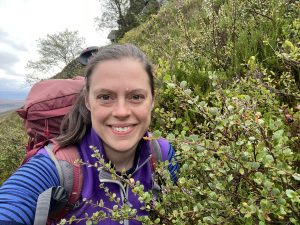
Sarah Watts in regenerating Dwarf Birch mountain woodland. Photo by Sarah Watts
As Sarah says, “National deer density targets are currently set at 10 per km² across open range areas of the Highlands, but numbers vary locally from below one to over 64 per km². These figures are too high for the restoration of sensitive upland habitats such as woodlands and scrub.
“Deer are an essential, celebrated part of our natural and cultural heritage. But action to address this imbalance would promote more sustainable, healthy deer populations, facilitate the recovery of other iconic woodland habitats, such as Caledonian Pinewoods and Atlantic Rainforests, and boost the general condition and diversity of our uplands.”
The research involved a six-year long high-altitude tree planting experiment repeated at three upland sites in the Scottish Highlands that are managed for nature restoration: Ben Lawers National Nature Reserve (National Trust for Scotland), Corrour Estate, and Glen Finglas (Woodland Trust Scotland).
Outcomes
The study Thinking outside the bog: Planting Dwarf Birch (Betula nana) for mountain woodland restoration beyond habitat refugia constrained by overgrazing was published in the journal Forest Ecology and Management in January 2026.
Lead author Sarah Watts now hopes that the study’s findings will help to restore lost woodlands in Scottish mountains – and shape future woodland creation strategies.
Work was funded by the University of Stirling, Woodland Trust Scotland, Corrour Estate, Scottish Forestry Trust, Macaulay Development Trust, National Trust for Scotland, Forest Research, and Future Woodlands Scotland.