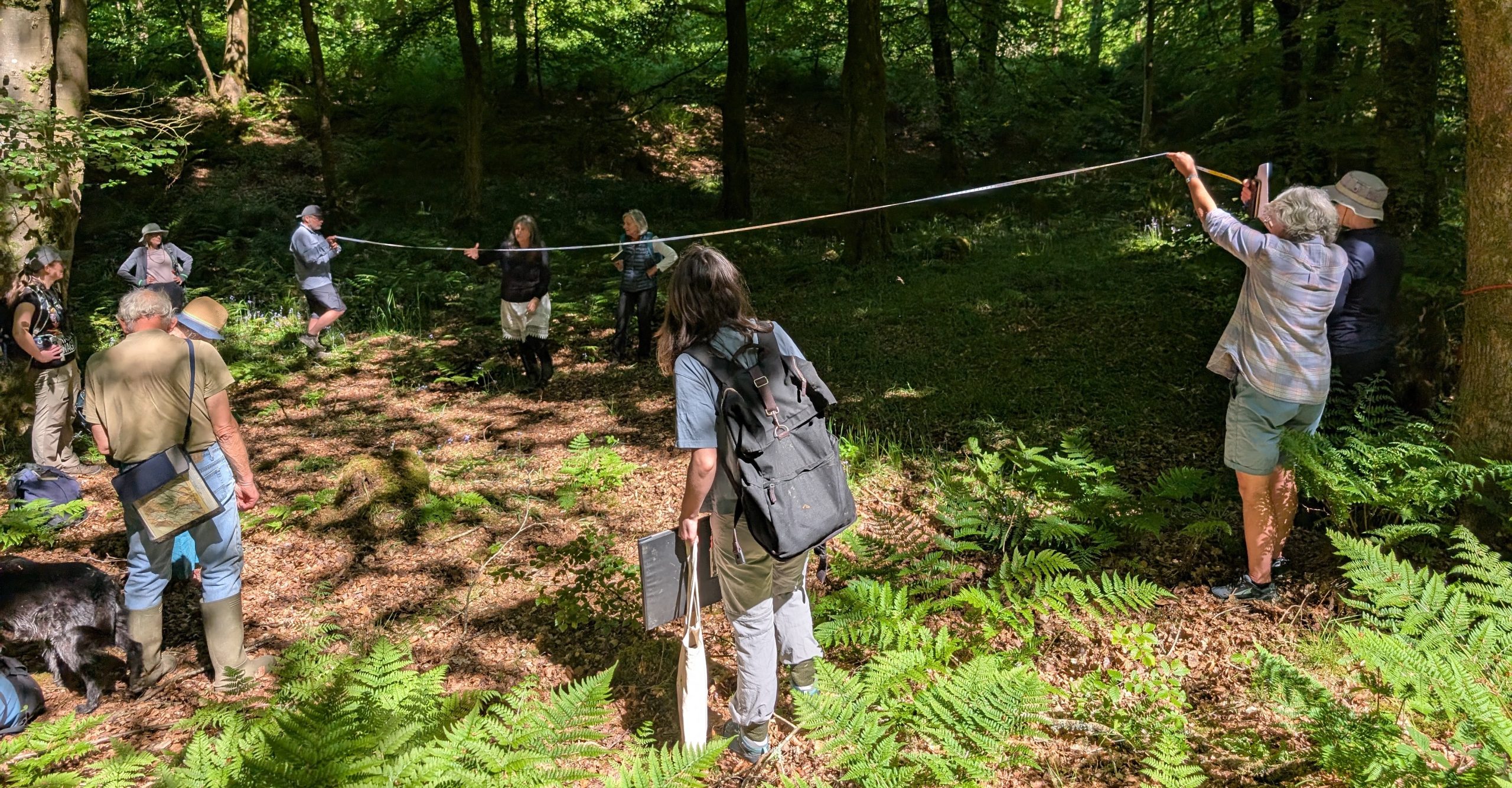
Kilsture Forest Community Group (KFCG) is developing a replicable WCA methodology designed for use by people with no previous experience or training, responding to a recognised need across community woodland groups for practical, systematic approaches to monitoring biodiversity change.
The project is driven by dialogue between four community woodland groups, including KFCG, and independent ecologists Dr Petra Guy and Julija Fediajevaite (the ecologists) with trustee Professor Anna Lawrence supporting development of the framework, analysis and conclusions of the project.
This application supports the next stage of development of a very successful ‘work-in-progress’ model created by the ecologists for a group of 20 volunteers collecting data in Kilsture Forest over 2 years. To date, KFCG has been dependent on the ecologists to analyse, interpret and apply the data. In this next stage the ecologists will extend the methodology to include an automated analysis pathway, processing the data to create outputs tailored to inform woodland management interventions. This will be designed to be used by volunteers, giving communities’ autonomy over all phases of the WCA from data collection, analysis and interpretation with suggestions on application.
The objectives are to:
- create a model of WCA for biodiversity that is accessible and operable by people with no previous ecological experience
- generate credible, understandable and useful evidence about biodiversity outcomes and ecosystem health
- gain insight into the efficacy and impact of this methodology to contribute to citizen science-led biodiversity restoration.
Our aim is not to replace existing professional methods but to adapt them for use by community woodland groups and citizen scientists. To achieve this, the ecologists have modified elements of the existing approach by:
- simplifying and grouping canopy structure criteria
- expanding and adapting plant diversity measures using indicator-based approaches informed by Ellenberg values
- standardising survey plot guidance to improve repeatability over time
- introducing measures that reduce observer subjectivity, for example through clearly defined tree age-class categories.
The resulting methodology retains the ecological principles underpinning established woodland condition assessments while making them accessible to volunteers without specialist training. A key objective of the project is to test whether such an adapted methodology can generate sufficiently robust information to support woodland management and biodiversity decision-making within community woodland settings.