In 2023, the Isle of Gigha Heritage Trust (IGHT) undertook a two year project to begin control of 20 hectares of INNS that would improve woodland structure, increase diversity and natural regeneration opportunity, as well as improve woodland sites that contain pathways for their community and visitors.
Whilst successful in kick-starting landscape scale control of R.ponticum, skunk cabbage and Himalayan balsam, the main challenge was that the mapping methodology (ground surveys, aerial photography, and GIS) was primitive, did not indicate the extent of the infestation and therefore did not inform appropriate management methods. The methodology did not include volume and density of plants, or accurate assessments of topography within stands. This consequently misinformed contractors of the scale of the works, increased costs mid project, reduced the area that could be treated within the project, and caused R.ponticum to be missed which continued to seed into the following growing seasons.
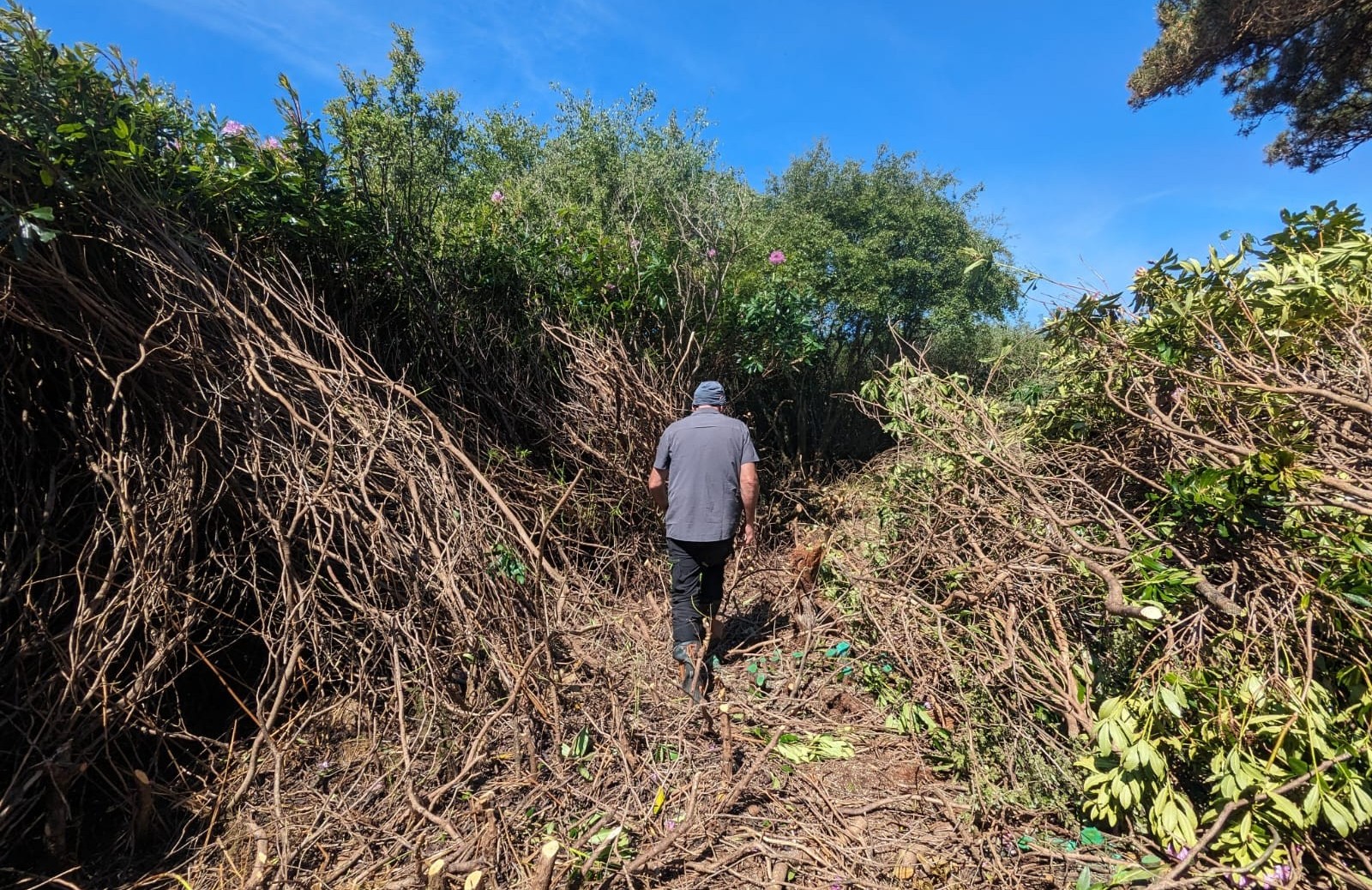
The growth of R.ponticum on Gigha is multi-stemmed due to the wind and salt pressure of their coastal environment. Like R.ponticum across much of Argyll, it does not grow into mature trees, but uses its ability to spread smaller branches outwards and underneath the ground which then produce multiple shoots from one branch, making the stands extremely dense, intertwined, and often impenetrable. When compiling a brief for contractors, it was difficult to relay how extensive the stands were, meaning more difficult work than expected, unrealistic budgets, and longer treatment times.
Having reached out to other organisations with similar aims, advanced drone surveys were suggested, but few examples could be found where drone imaging and analysis was being used to map R.ponticum and make these maps usable for treatment purposes. Common issues were identified with other drone technology, e.g. cloud cover, dense canopy cover and topography reducing the capacity to produce accurate maps. But RTKMS was identified as a potential solution.
This project will trial RTK multispectral surveys that will aim to provide more accurate data and maps that include presence, volume, density of R.ponticum as well as topography across Gigha to inform future community treatment programmes.
The project will also undertake a comparative analysis of their original mapping methods (aerial photography and ground surveys compiled into GIS) and RTKMS to contribute to the research of invasive non-native species (INNS) mapping, and hopefully provide learning for organisations of R.ponticum mapping and management.