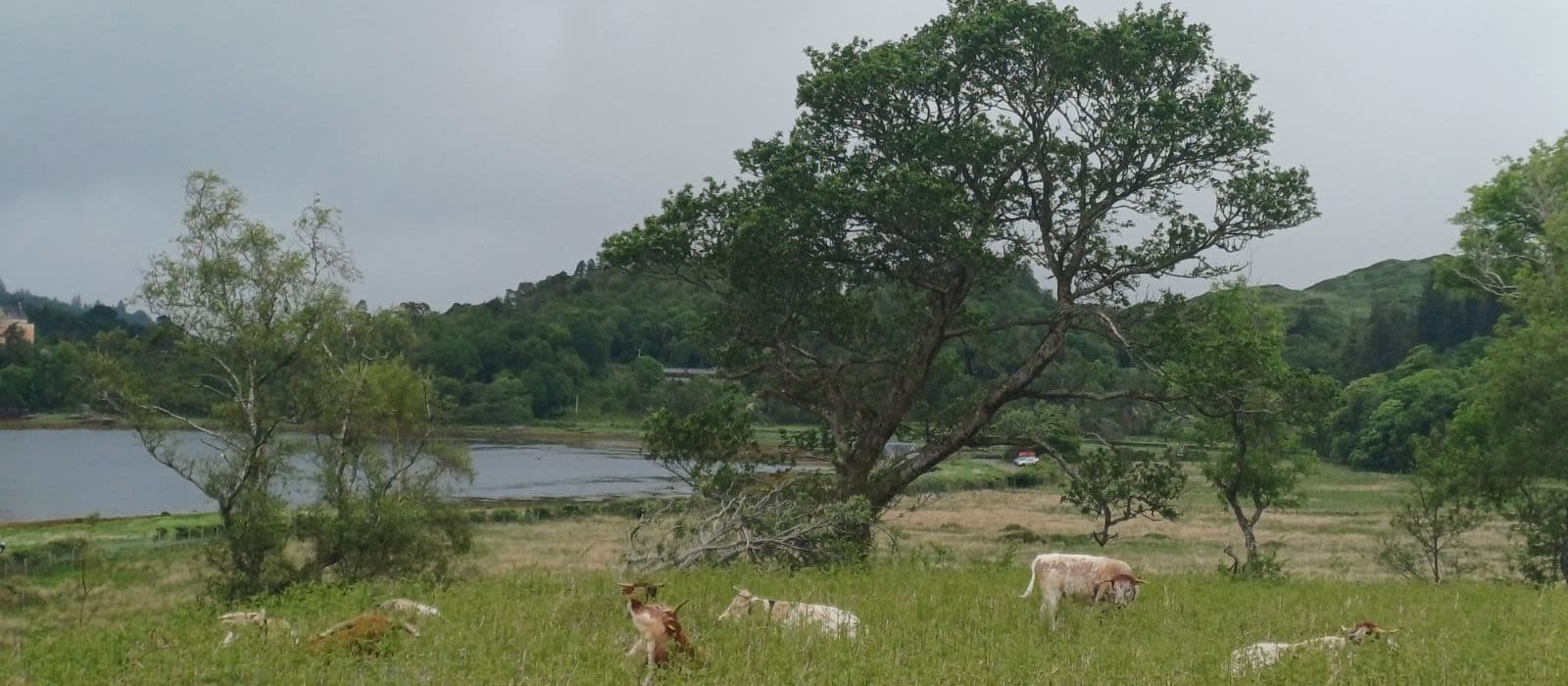
This project will build and evidence a local “wilder grazing” service focused on recovering ghost woodlands and Atlantic rainforest fragments at Ardtornish Estate and partner land in southeast Morvern. Ghost woodlands are ancient woodland remnants where regeneration has been heavily suppressed by historic herbivory, yet recover rapidly when browsing pressure is reduced and natural disturbance processes return. The west‑coast rainforest system is internationally important but fragile, with many stands simplified or static after decades of overbrowsing or subsequent undergrazing. The project will use low‑density, behaviour‑led cattle grazing, supported by ponies for low‑impact herding, to suppress bracken and Molinia dominance, create niches for woodland flora and seedling establishment; stimulating natural regeneration. Delivery is adaptive: timing, density and movement respond directly to ecological signals captured through grazier‑led monitoring, estate Woodland Herbivore Impact Assessment (WHIA) data, fixed‑point photography and regeneration plots.
- Measurable reduction in browsing pressure within ghost woodland compartments, evidenced by WHIA improvements and increased seedling/sapling recruitment.
- Established, replicable, adaptive contract-grazing service with monitoring workflow, demonstrating wilder grazing as a tool for rainforest/ghost woodland recovery.
- Learning outputs produced. Two practitioner workshops will be delivered, alongside a concise guidance note with monitoring templates, and an on-site demonstration day. An anonymised dataset and case study will be shared to support replication. Learning from mineral-block trials, vegetation responses and adaptive livestock management will be incorporated into sector guidance.
The project is co-delivered by Ardtornish Estate (host, deer management, governance) and Nomios Pastoral (adaptive grazing, monitoring, ecological interpretation) working with the CalaMhor herd of free-ranging ponies, Scottish Wildlife Trust (Rahoy Hills Reserve) and Glensanda Estate as neighbouring partners. Internal and external stakeholder workshops will be used for collaboration between ecologists, community and graziers.
Read a recent blog post about the project.