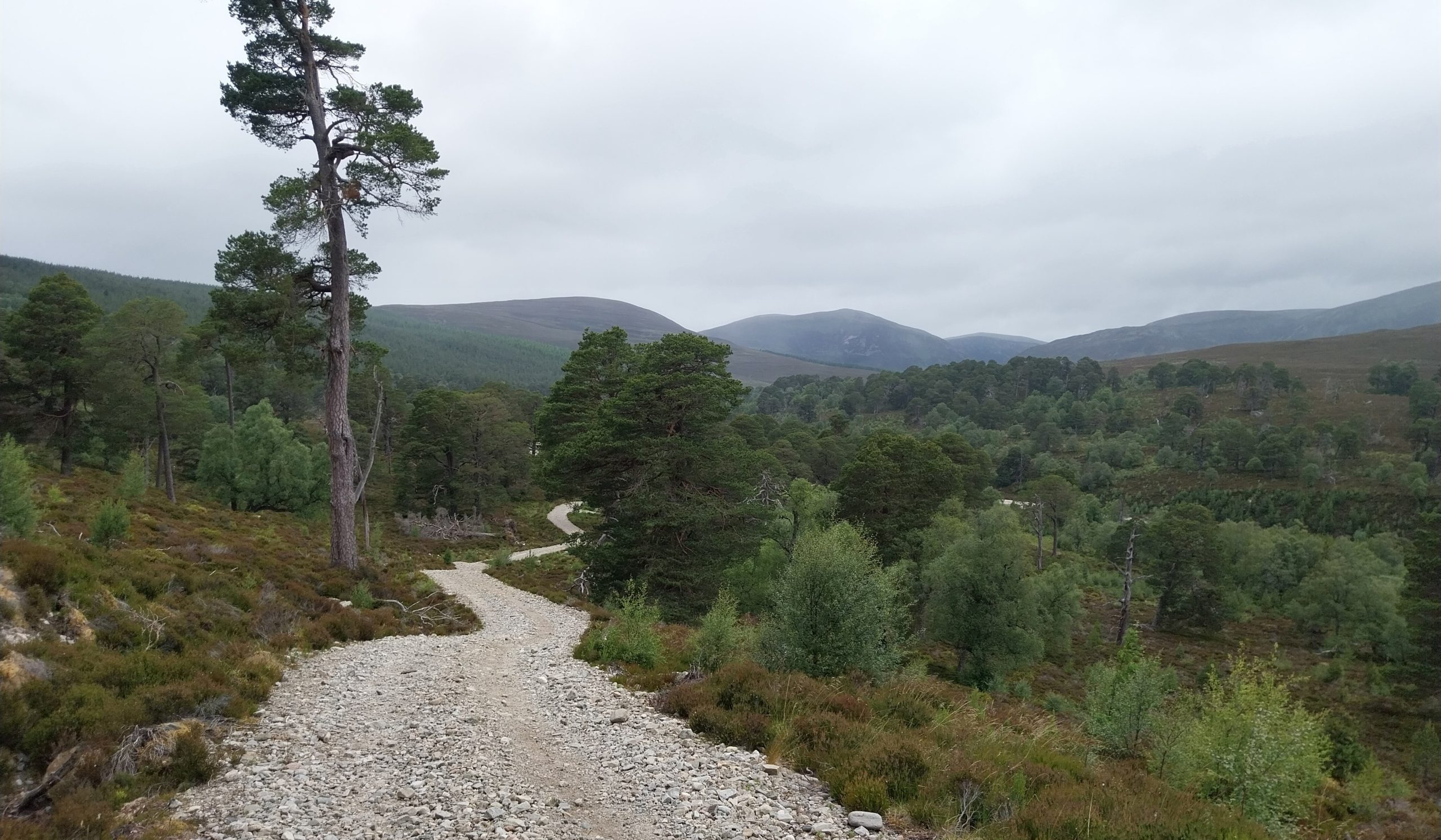
This project led by Francesca Darvill aims to establish a long‑term monitoring programme to understand how naturally regenerating Scots pine seedlings influence soil carbon (C) dynamics across carbon-rich soils in at Mar Lodge Estate. Reforestation is widely promoted as a climate mitigation strategy, yet recent evidence suggests that woodland creation on carbon‑rich soils may lead to soil organic carbon (SOC) losses. Natural regeneration is increasingly favoured as a low‑disturbance approach, but baseline data describing how regeneration patterns relate to soil properties remain scarce.
Francesca’s recent collaborative work with the National Trust for Scotland has begun to address this gap. Preliminary findings show that naturally regenerated Scots pine seedlings occur in soils with shallower O horizons and lower SOC stocks. This monitoring programme will generate a robust dataset capable of revealing how early tree establishment influences soil carbon pools, decomposition, and microbial dynamics.
The project’s objectives during this stage include:
- Establishing baseline measurements and tracking annual change in O‑horizon thickness, soil moisture and carbon stock around newly established naturally regenerating seedlings across carbon‑rich soils at Mar Lodge, enabling us to distinguish inherent soil variability from early tree‑driven effects.
- Observing early root system development and its influence on carbon-rich soils – measuring how seedlings begin to interact with and influence carbon rich soils by installing and monitoring mesh root‑influence traps, providing evidence of rooting influence on future observed soil carbon gradients.
- Characterising baseline microbial and fungal communities – identifying and tracking changes in fungal and microbial communities adjacent to newly established seedlings using fungal mesh traps and microbial profiling to help reveal below-ground mechanisms driving change in soil carbon dynamics.